
An Indiana Jones of Armenia
“Every family has a legend. Ours happens to hike Armenia’s highest mountains in search of ancient rock art.”
If there were ever an Indiana Jones of Armenia, in my mind his name would be Karen Tokhatyan.

I first met Karen fifteen years ago at my father-in-law’s funeral. It was my first trip to Armenia, made under devastating circumstances. Karen is a close relative on my Armenian side of the family, a world-renowned scholar and historian who specializes in Armenian rock art. He has dedicated his life to studying and documenting Armenia’s prehistoric petroglyphs carved into stone. Karen could out-hike us all any day of the week—and, as I recently discovered, we also share a love for pasta.
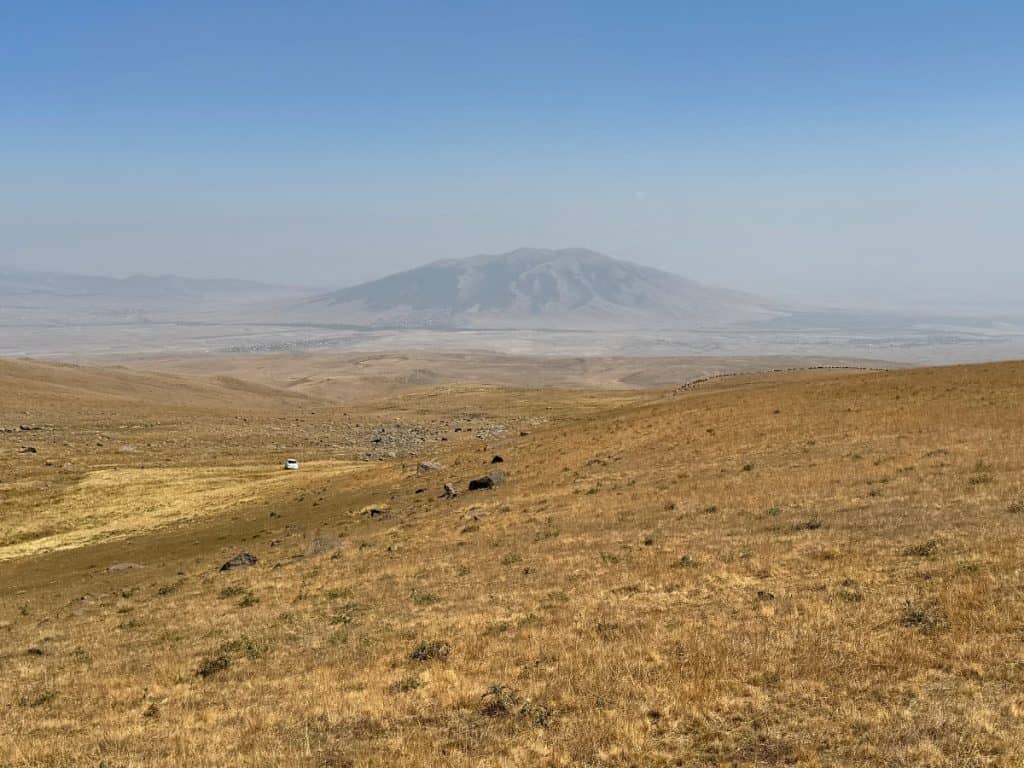
On two occasions, Karen took my family and me up into the Mount Aragats valleys to see rock art with him. Each trip was an adventure.
On our first expedition, we hiked the outer foothills and slopes of Aragats near Amberd Fortress, searching for undiscovered rock art in the Armenian Highlands. I remember carefully scanning massive stone boulders, their surfaces polished smooth by thousands of years of wind and weather, almost varnish-like in appearance, hoping to spot a carving. That trip truly felt like an adventure. We were briefly separated from Karen and had to push through lightning and thunder from an approaching storm, nearly taking shelter with local highland Yazidis along the way.
On a more recent trip, Karen led us along a different route in the Aragats highlands. This time, we encountered original dragon stones and mountain valleys filled with breathtaking rock art petroglyphys thousands of years old. My son helped Karen take measurements and collect field data for his research, while my wife and I wandered in awe, absorbing the beauty of the carvings and trying to decipher their meanings. Karen patiently explained many of the symbols and drawings to us—and my wife even managed to spot one carving that Karen himself hadn’t noticed before. What astonished me was how deep the stone carvings were; they look very shallow until you touch them and really feel their depth.

Recently, Karen published a book documenting his life’s work—a comprehensive volume that will preserve Armenia’s rock art for generations to come. We are immensely proud of him, but not just us. Armenia is proud of him. Whenever his name comes up among my friends, the admiration is immediate and sincere. Karen is not only a great scholar, but a deeply respected and beloved person. He is, in every sense, a national treasure and a cherished friend to many.